


 Italy
 Canada
 Czech Republic
 Denmark
 Malta
 Sweden
 Germany
 Ireland
 Norway
 Hungary
 Lithuania
 Greece
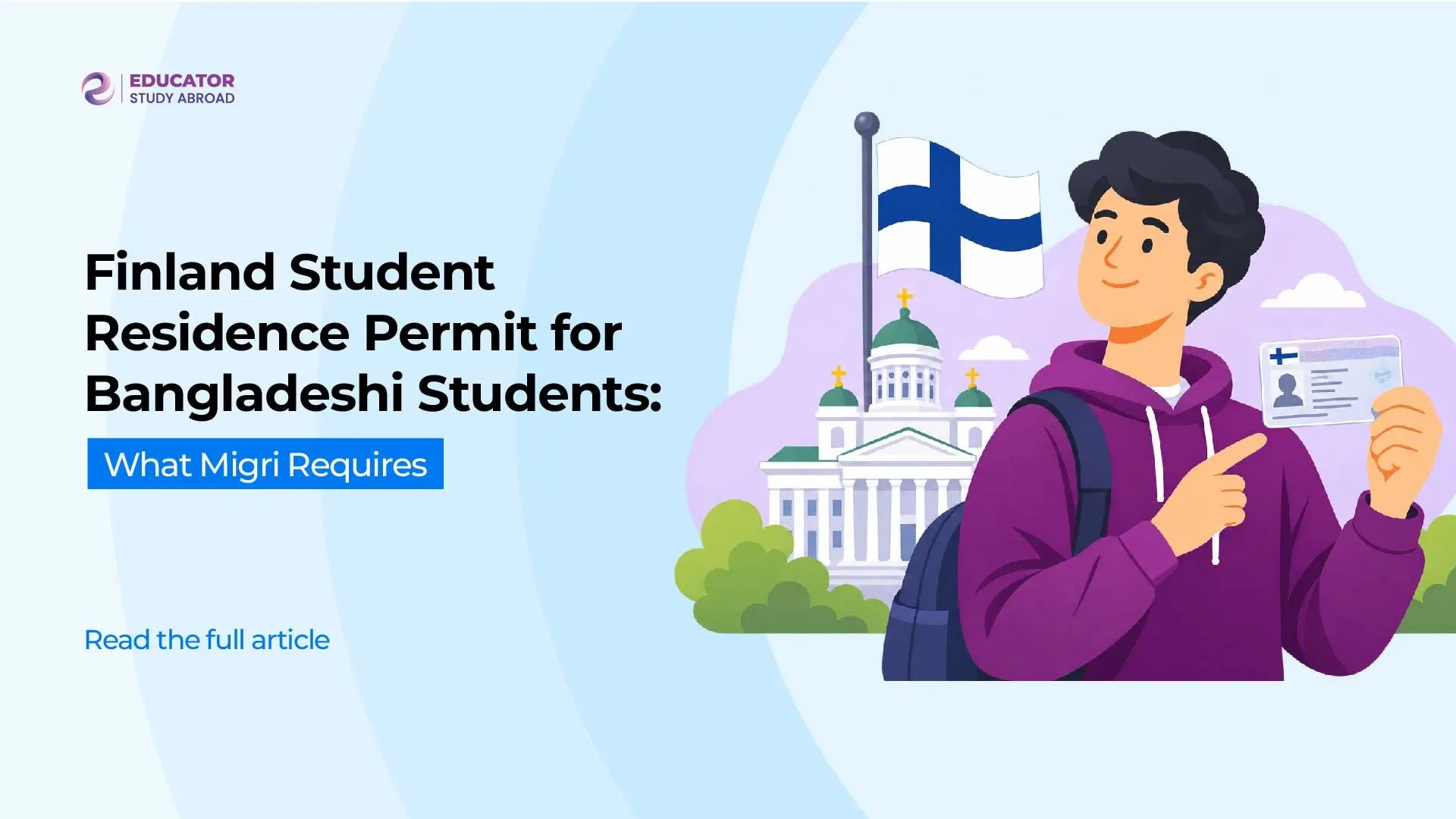
Finland Student Residence Permit for Bangladeshi Students: What Migri Requires
November 10, 2026 · 6 min read
Last verified: 9 November 2026. Fees, dates and immigration rules can change, so always confirm with the university and Migri before you act.
If you are a Bangladeshi citizen admitted to a Finnish university or university of applied sciences, you need a residence permit for studies. The permit is handled by the Finnish Immigration Service, Migri. This article explains the main rules as published by Migri so you can prepare your finances and documents realistically.
The financial requirement
How much money is required?
Migri states you need at least EUR 800 per month at your disposal. For studies lasting one year or longer, this means EUR 9,600 in your bank account when you submit the application. For studies shorter than a year, the amount is EUR 800 per month.
Does tuition count?
No. Tuition fees must be covered in addition to living costs. According to Migri: - If you have already paid the tuition fee, attach proof of payment and still show living funds. - If you pay after applying, your account must hold the first year's tuition plus living costs at the time of application. Living funds cannot be used to pay tuition. - If you have a tuition scholarship, attach the institution's certificate. Living funds are still required.
Can the institution reduce the amount?
Migri notes that support provided by the institution can lower the requirement: EUR 400 per month if free accommodation is provided, and EUR 270 per month if free accommodation and free meals are provided.
Proving your funds
Bank statement
Migri asks for a bank statement covering the past six months showing the account holder's name, the bank name and the currency.
The account must be your own
The funds must be in your personal use. Sponsorship agreements from relatives, friends or employers are not accepted. If money came from someone else, Migri may ask for documents showing its origin, such as a tax certificate or the sponsor's bank statement.
Scholarships
Scholarship or grant decisions are attached and count toward the requirement.
Application fee
Migri changed its processing fees on 1 January 2026. For a first residence permit for studies, the online application fee increased to EUR 600 (previously EUR 450), and the paper application fee increased to EUR 750 (previously EUR 550). Applications that were already pending on 31 December 2025 are charged the 2025 fee. Migri says the online fee is lower than the paper fee. Fees can change again, so check Migri's current fee page or Enter Finland before paying. Extension fees are listed on Migri's "Processing fees and payment methods" page.
How to apply
Applications are normally submitted online through Enter Finland, Migri's e-service. Paper applications are possible only when the e-service cannot be used. Your university will give you an admission letter, which is part of your application. Your counsellor can guide you through the document list for your situation.
Permit duration and extensions
A permit can be granted for the entire duration of your studies, according to Migri. Extended permits are for students whose studies continue after the permit is about to expire. Migri's guidance for extensions: - Apply before your current permit expires; Migri does not recommend applying earlier than three months before the expiry date. - You need to show study progress. Migri refers to about 45 ECTS credits per academic year at a higher education institution, or the reasons if fewer. - You must again have at least EUR 800 per month available. - You need insurance cover; a Kela card, EHIC or GHIC is accepted as a certificate.
Common mistakes to avoid
Depositing money at the last minute. The statement covers six months, so unexplained large deposits may raise questions.
Relying on a sponsor. Sponsorship agreements are not accepted.
Forgetting tuition. The EUR 9,600 is for living, not tuition.
Applying for an extension too early. Do not apply until you have completed the required credits.
A step-by-step way to prepare your finances
Most permit problems come from money, not paperwork. Use this order:
Work out your total. Add one year of tuition (if you have not paid it) to EUR 9,600 for living costs. Migri states that if you pay tuition after applying, your account must hold the first year's tuition plus living costs when you apply.
Check the source of every deposit. Migri may ask for documents showing the origin of funds, such as a tax certificate or the sponsor's bank statement, if money came from another person.
Keep the money in your own account for the full period. Migri asks for a bank statement covering the past six months showing your name, the bank's name and the currency.
Plan for the whole permit period. Migri's funds rule applies during the entire period of validity of your residence permit, which is why extension applications ask for proof of funds again.
What a scholarship changes
If you receive a scholarship or grant, Migri says to attach the decision, and it counts toward the requirement. Migri's own example: EUR 9,600 minus a EUR 2,000 grant leaves EUR 7,600 to show. A tuition scholarship needs the institution's certificate, but living funds are still required.
Extension: what to know early
Many students forget the extension until the last moment. Migri's guidance:
Apply before your current permit expires, and not earlier than three months before the expiry date.
Do not apply until you have completed the required credits. Migri refers to about 45 ECTS credits per academic year at a higher education institution.
A Finnish bank deposit is described by Migri as the easiest and most reliable way to show funds for an extension; work income can also be used, with the employment contract attached.
Your residence permit card is not sent abroad, so you need a valid Finnish address.
If your extension application was filed in time, you may keep working while it is pending.
Insurance
Migri notes that insurance is required for extended permits, and that a Kela card, EHIC or GHIC is accepted as a certificate. Degree students also pay a healthcare fee to Kela; see student housing and student life for the 2026 amount.
Frequently asked questions
How much money do I need for a Finnish student visa?
EUR 800 per month; EUR 9,600 for studies of one year or longer, per Migri.
Can my parents sponsor me?
Sponsorship agreements from relatives are not accepted. The money must be in an account for your own use. Money received from relatives may need documents proving its origin.
Is the tuition fee included in the EUR 9,600?
No. Tuition is a separate requirement.
How long is the permit valid?
It can be granted for the entire duration of your studies, and you apply for extensions as needed.
Can I work on a student permit?
Yes, within limits. See working while studying in Finland.
Related reading
Sources
Migri, Income requirement for students, https://migri.fi/en/income-requirement-for-students
Migri, Application for an extended permit on the basis of studies, https://migri.fi/en/application-for-an-extended-permit-on-the-basis-of-studies
Migri, Changes to processing fees as of 1 January 2026, https://migri.fi/en/-/changes-to-finnish-immigration-service-processing-fees-as-of-1-january-2026
Migri, Processing fees and payment methods, https://migri.fi/en/processing-fees-and-payment-methods